
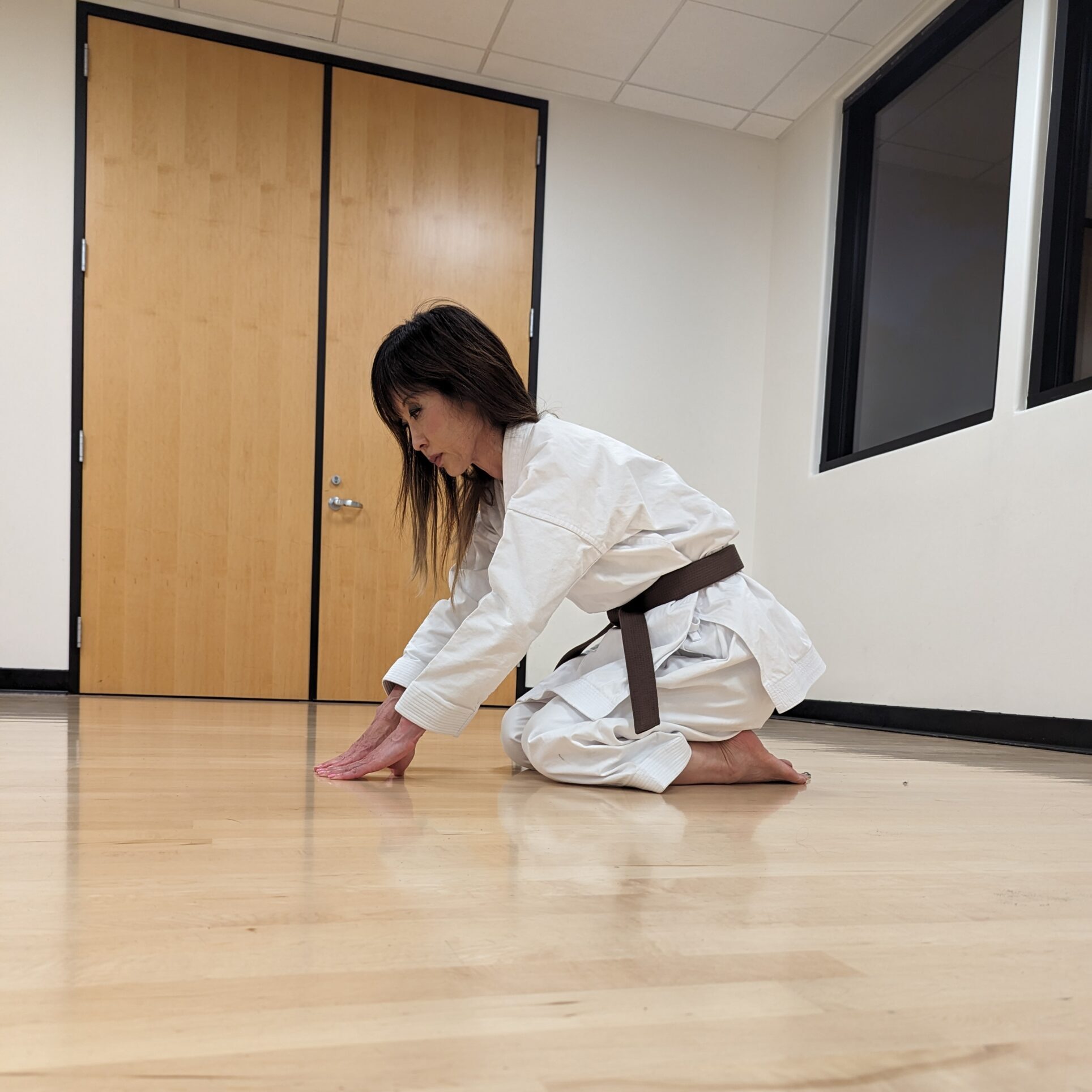
Seiza (正座) & Zarei (座礼): The Foundation of Dōjō Etiquette

Seated Bow – Zarei
The following educational excerpt is drawn directly from the Gōjū-Ryū Karate-Dō Desk Reference 剛柔流空手道 机参照: Volume 2: Dōjō Auxiliary, Glossary & Terminology 道場の補助、用語集 と 辞書.
Before a Karateka can perfect their strike or master their Kata, they must first learn how to sit. In traditional Japanese martial arts, Seiza (正座) and Zarei (座礼) form the bedrock of dojo etiquette (Reigi). These are not merely ceremonial gestures; they are calculated, deeply rooted martial postures designed to cultivate mindfulness, discipline, and physical readiness.
- Seiza 正座: Literally translating to “correct sitting” or “sitting straight,” this is the basic, formal upright kneeling position used in Karate-dō 空手道 and universally across Japanese Budō 武道.
- Zarei 座礼: The act of performing a formal bow from the seated position of Seiza. (Note: You can review the three specific degrees of Zarei in our expanded guide here.)
How to Sit in Proper Seiza (正座)
Transitioning into Seiza is a deliberate act that requires maintaining your Zanshin (残心)—your unbroken martial awareness. You should never simply “flop” onto the tatami.
To sit in Seiza, begin from a proper standing posture (Musubi Dachi or Heisoku Dachi) with your hands naturally at your sides. Keep your back completely straight and square above your hips at all times, then follow this precise sequence:
- Lower your hips, maintaining your center of gravity in vertical alignment.
- Bending your left leg first, slide your left foot backward.
- Bring your left knee down to the mat, placing it exactly where the ball of your left foot was previously located.
- Follow with your right leg, sliding your right foot backward and placing your right knee where the ball of your right foot was located.
The Transitional Pause (Kiza)
From this position, you should momentarily be seated on the balls of your feet with your toes bent forward against the floor (a posture known as Kiza). Pause for a short moment in this active, spring-loaded position. This ensures you are balanced and capable of launching forward if attacked. Finally, lay your toes flat and straight against the mat. You are now seated correctly in Seiza 正座.
- Foot Position: The tops of the feet should rest flat on the floor. They can rest side-by-side or the big toes may lightly cross, but the feet should not heavily overlap on top of each other.
- For Ladies: The legs should be closed with the knees kept together.
- For Gentlemen: The knees should drift slightly apart to provide a stable base, typically spaced about one to two fist-widths (or approximately one knee-width) apart.
- Hand Placement: Hands should rest lightly on the upper thighs, near the crease of the hips, with fingers together.
The Martial Purpose: Why the Left Knee First?
In Japanese martial arts, the rule of going down on the left knee first and rising on the right foot first is rooted deeply in samurai history (often referred to as Saza Uki). Historically, swords were worn on the left side of the obi (belt). By dropping to the left knee first, the right leg remains planted longer, ensuring the strong side is stable and the right hand is free to draw the blade at a moment’s notice. While modern Karateka do not wear swords, we preserve this sequence to honor our martial lineage and maintain optimal defensive readiness.
Returning to Kamae (Standing Up)
To return to a standing position, you must perform the sequence in the exact opposite order.
Raise your hips and tuck your toes under to return to the active Kiza position. Step up beginning with the right leg first. Remember to keep your posture tall and your back vertical by engaging your core muscle network. Never use your hands to push yourself up off the floor. You should seamlessly center your shoulders directly above your hips, and your hips directly above your feet, returning to a state of calm readiness.
To elevate your understanding of authentic Japanese dōjō protocols, grading requirements, and terminology, the full Gōjū-Ryū Karate-Dō Desk Reference is available for comprehensive study.
Ready to Begin Your Karate Journey?
Join Seiwakai Karate Silicon Valley. We offer authentic, traditional instruction for adults and families across the Bay Area.
Discover more from SEIWAKAI KARATE SILICON VALLEY
Subscribe to get the latest posts sent to your email.
