
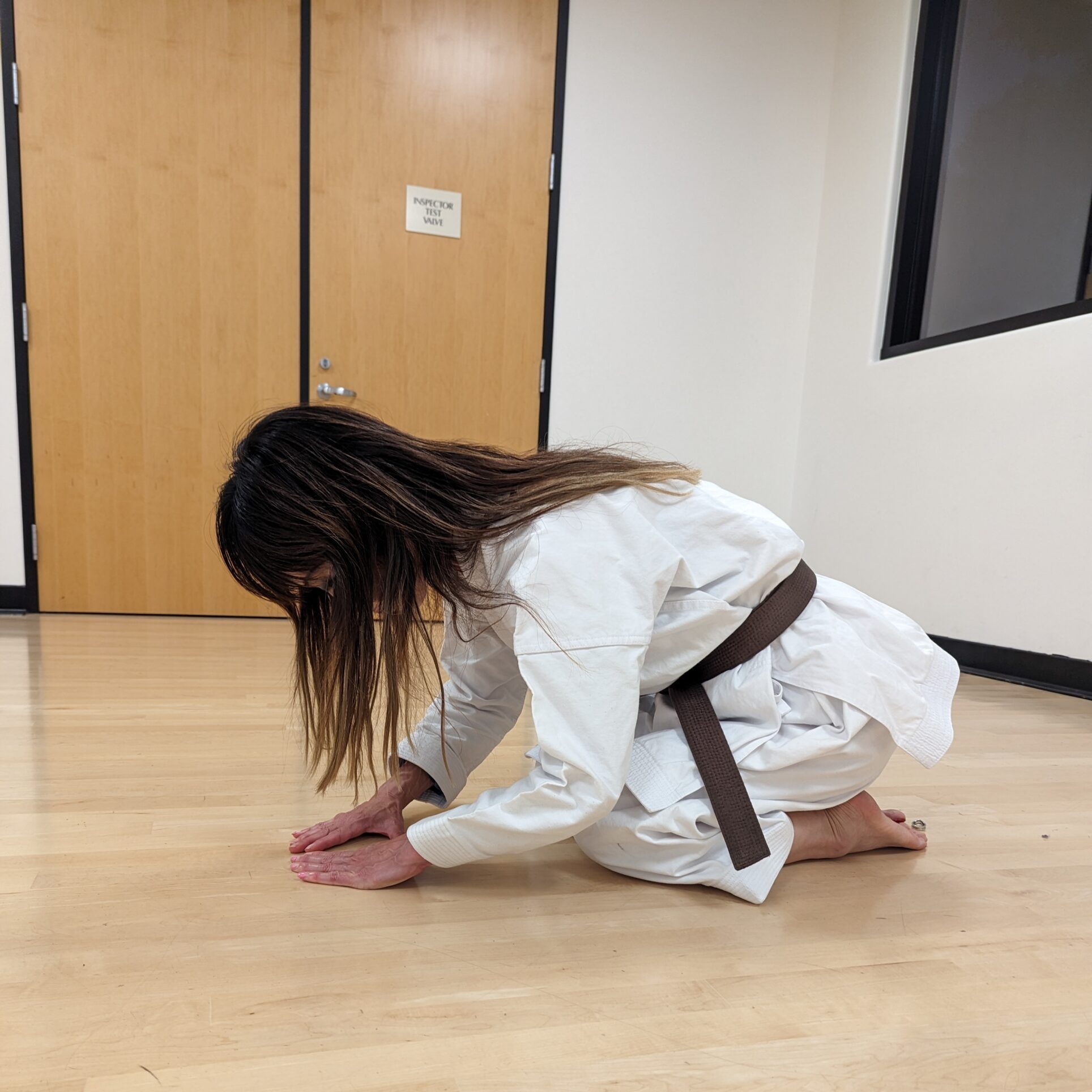
Zarei (座礼): The Three Degrees of Traditional Seated Bows

Zarei – Seated Bow
The following educational excerpt is drawn directly from the Gōjū-Ryū Karate-Dō Desk Reference 剛柔流空手道 机参照: Volume 2: Dōjō Auxiliary, Glossary & Terminology 道場の補助、用語集 と 辞書.
In traditional Japanese martial arts, physical technique is only half of the journey; proper etiquette (Reigi) is equally vital. Zarei (座礼) is performed from Seiza (正座), the formal sitting posture. Just as with Ritsurei (立礼)—the standing bow—there are three distinct degrees of bowing from a kneeling position. Understanding when and how to execute each is a fundamental expectation for any serious Budōka (武道家).
The terminology for the three degrees of the seated bow are Senrei (浅礼), Futsūrei (普通礼), and Saikeirei (最敬礼).
1. Saikeirei (最敬礼) – The Deep Bow
Saikeirei is a highly respectful, polite, and deeply seated bow. This is the standard Zarei you must use in all formal Budō (武道) settings.
- Bend at the waist, bowing down to an angle of approximately 90°.
- Place your hands on the floor in front of you simultaneously, forming the shape of a diamond (Urasenke 裏千家 style) with the fingers lightly touching.
- Crucial: Do not expose the back of your neck or touch your forehead directly to the floor.
- Wait to raise your head from the bow until after your seniors (Senpai 先輩, Sensei 先生, or Shihan 師範) have done so.
- Smoothly place your palms back onto your thighs, resting just above your knees.
2. Futsūrei (普通礼) – The Standard Bow
Futsūrei is a standard bow, though it is not as commonly utilized on the tatami in Karate-Dō (空手道) or Budō as the deeper Saikeirei.
- Bend at the waist to bow down to an angle of approximately 45°.
3. Senrei (浅礼) – The Shallow Bow
Senrei is the least formal seated bow and is generally uncommon for junior students to use in Karate-Dō or Budō.
- Bend at the waist to bow down slightly to an angle of approximately 20°.
- Keep your hands closer together and closer to your knees, lightly touching only the tips of your fingers to the floor.
- This is the specific bow that senior instructors may use as a brief acknowledgement to juniors.
Practical Application on the Tatami
For our students training at Seiwakai Karate Silicon Valley, understanding these distinctions is a core part of your development. You will execute Saikeirei at the beginning and end of every class during our traditional bow-in (Mokusō, Shōmen ni rei, Sensei ni rei).
As you prepare for upcoming Kyu gradings, remember that the evaluation panel is watching your Reigi (etiquette) just as closely as your Kihon and Kata. A rushed, sloppy bow, or dropping your head too far, breaks your martial awareness and demonstrates a lack of focus.
A Warning on Dogeza (土下座)
Zarei encompasses high expectations for all practitioners. Always remember not to drop your head so low that you expose the back of your neck to the room. A bow that exposes the neck and touches the head to the floor is called Dogeza (土下座), and it is specifically reserved for the deepest, most desperate of sincere apologies or total submission. It is highly inappropriate for standard dōjō etiquette.
To deepen your understanding of authentic Japanese dōjō protocols and terminology, the full Gōjū-Ryū Karate-Dō Desk Reference is available for comprehensive study.
Ready to Begin Your Karate Journey?
Join Seiwakai Karate Silicon Valley. We offer authentic, traditional instruction for adults and families across the Bay Area.
Discover more from SEIWAKAI KARATE SILICON VALLEY
Subscribe to get the latest posts sent to your email.
