
Gōjū-Ryū vs. Shōtōkan-Ryū: An Academic and Tactical Analysis of Traditional Karate
While both Gōjū-Ryū and Shōtōkan-Ryū share a common genesis in the indigenous martial arts of Okinawa, they represent distinct evolutionary branches of combat. Having spent over five decades on the Dōjō floor—both researching the historical timelines in Japan and testing these mechanics in international competition—I have found that understanding the divergence of these two powerhouse styles is essential for any serious student of Budō.
Each style followed a different geographical and philosophical path to arrive at highly effective, yet tactically opposing, combative destinations. To truly understand traditional Japanese martial arts, we must look beyond the surface of their techniques and examine their unique approaches to cultural lineage, biomechanics, and combat philosophy.
Gōjū-Ryū (剛柔流): The Art of Hard and Soft Infighting
Founded by Chōjun Miyagi in early 20th-century Okinawa, Gōjū-Ryū translates to the “Hard-Soft Style.” Rooted deeply in the Naha-te lineage and heavily influenced by the internal Chinese martial arts of Fujian (such as White Crane), this system is a masterclass in close-quarter combat.
Tactically, Gōjū-Ryū is designed for the infight. The mechanics emphasize circular blocks, deflections, and the seamless transition between yielding to force (soft) and delivering devastating counter-strikes (hard). Beyond standard striking, Gōjū-Ryū integrates extensive close-range techniques, including Tuite (joint locks), standing grappling, and sweeps.
From an academic and developmental standpoint, Gōjū-Ryū places an immense emphasis on the internal architecture of the body. Through foundational Kata like Sanchin and Tenshō, practitioners engage in rigorous Ibuki (dynamic tension breathing) and meditation. This internal focus develops a robust physical armor and a grounded, immovable foundation designed to overwhelm opponents at zero distance.
Shōtōkan-Ryū (松濤館流): The Dynamic Power of Long-Range Engagement
Developed by Gichin Funakoshi—and further refined by his son Yoshitaka (Gigō) Funakoshi and the early instructors of the Japan Karate Association (JKA)—Shōtōkan-Ryū traces its roots to the fast, mobile Shuri-te and Tomari-te lineages of Okinawa. The name translates to “House of Waving Pines,” originating from Funakoshi’s poetic pen name.
When Funakoshi brought his art to mainland Japan, it was heavily adapted to align with the Japanese university system and the native concepts of Kendō (Japanese fencing). As a result, Shōtōkan-Ryū evolved into a highly dynamic, linear style engineered for long-distance combat. It focuses on maximizing speed, explosive power, and maximizing reach. Shōtōkan practitioners utilize deep, elongated stances to launch themselves rapidly across the floor, delivering decisive, one-strike finishes (Ikken Hissatsu).
While Gōjū-Ryū seeks to trap and dismantle, Shōtōkan-Ryū seeks to intercept and obliterate from the outside. Its curriculum heavily emphasizes repeated, precise mechanical drilling (Kihon) and a vast catalog of Kata designed to perfect muscular timing, speed, and kinetic expansion.
Kumite (Sparring) Philosophies: Kakie vs. Sun-dome
The philosophical divide between the two styles is perhaps most evident in their approach to Kumite (sparring). Gōjū-Ryū practitioners historically favored continuous, closer-range engagement, utilizing exercises like Kakie (pushing/sticking hands) and Irikumi (continuous sparring) to feel an opponent’s center of gravity and disrupt it.
Conversely, the mainland development of Shōtōkan-Ryū championed Sun-dome—the concept of arresting a full-power strike just millimeters from the target. This philosophy of absolute control birthed the modern point-sparring format seen in World Karate Federation (WKF) competitions today, heavily favoring the rapid, linear blitzing techniques inherent to Shōtōkan.
Tactical Comparison: The Biomechanics of Combat
| Attribute | Gōjū-Ryū (剛柔流) | Shōtōkan-Ryū (松濤館流) |
|---|---|---|
| Combat Distance | Close-quarter (Infighting) | Long-range (Outfighting) |
| Movement Trajectory | Circular evasion and deflection | Linear, explosive entry and exit |
| Okinawan Lineage | Naha-te (Fujian White Crane roots) | Shuri-te / Tomari-te |
| Stance Architecture | Shorter, compact rooted stances (e.g., Sanchin-dachi) | Deep, elongated stances (e.g., Zenkutsu-dachi) |
| Breathing Mechanics | Ibuki (Hard, audible tension breathing) | Natural breathing with explosive Kiai |
Conclusion: Two Paths, One Mountain
Both Gōjū-Ryū and Shōtōkan-Ryū have profoundly shaped the global landscape of martial arts. Whether a practitioner prefers the grounded, breath-powered infighting of Miyagi’s system or the lightning-fast, explosive striking of Funakoshi’s lineage, both styles offer a lifelong journey. While their mechanical delivery systems differ drastically, both possess a rich historical pedigree and offer immense physical, mental, and spiritual refinement to the dedicated student of cultivating inner strength.
Frequently Asked Questions
Is Gōjū-Ryū or Shōtōkan better for self-defense?
Both are highly effective, but they excel in different ranges. Gōjū-Ryū provides excellent tools for grappling, joint manipulation, and close-quarter protection, making it ideal for confined spaces. Shōtōkan excels in managing distance, allowing a practitioner to intercept threats rapidly from the outside or evade effectively.
Do both styles practice the same Kata?
No. While there are a few overlapping sequences due to cross-pollination in early Okinawan history, their Kata catalogs are distinctly different. Gōjū-Ryū utilizes Kata like Sanchin, Seienchin, and Suparinpei. Shōtōkan is famous for the Heian series, Bassai Dai, and Kanku Dai.
Experience Traditional Gōjū-Ryū
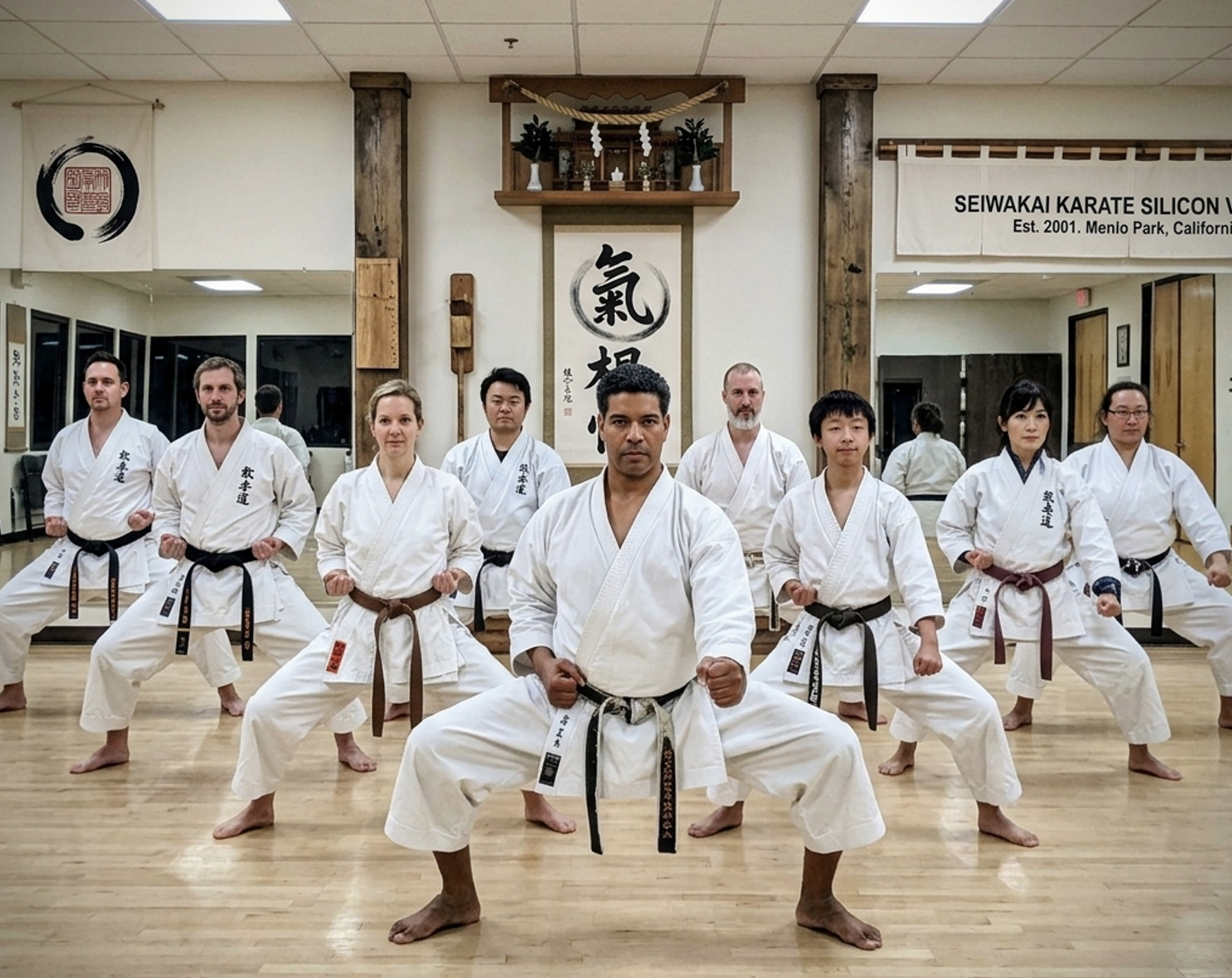
Ready to experience the close-quarter mechanics and internal power of traditional Gōjū-Ryū firsthand? If you are in the San Francisco Bay Area, come train with us at Seiwakai Karate Silicon Valley in Menlo Park. For practitioners worldwide looking to deepen their historical and technical understanding, pick up your copy of the Gōjū-Ryū Karate-Dō Desk Reference today.
About the Author
Johnpaul Williams Shihan is the Director of Seiwakai Karate Silicon Valley and holds advanced teaching licenses (Kyōshi and Renshi Shihan) in Gōjū-Ryū Karatedō. With over five decades of traditional training, active international competition experience, and rigorous academic research in Japan, he is the author of the celebrated publication, Volume 1 Gōjū-Ryū Karate-Dō Desk Reference 剛柔流空手道 参考書 – Introduction & Historic Chronology.
Discover more from SEIWAKAI KARATE SILICON VALLEY
Subscribe to get the latest posts sent to your email.
